A roof can look attractive from the street and still be the wrong system for the building. The best material must suit the slope, deck condition, structural capacity, local weather, maintenance expectations, and budget. Comparing the main types of shingles therefore involves more than choosing a color or accepting the longest advertised warranty.
Quick answer: The nine popular types of shingles are three-tab asphalt, architectural asphalt, luxury asphalt, wood shingles, cedar shakes, metal shingles, natural slate, composite shingles, and solar shingles. No material is best for every property; the right choice depends on the roof and the owner’s long-term plans.
What Are Roof Shingles?
Roof shingles are overlapping pieces that shed water down a sloped roof and create its visible finish.
Shingles are only one part of the assembly. The deck, underlayment, flashing, fasteners, ventilation, and drainage details all affect performance. A premium shingle installed over weak decking or poor flashing can fail early. The Asphalt Roofing Manufacturers Association also identifies underlayment, ventilation, starter strips, ice-and-water barriers, and ridge products as important parts of an asphalt roofing system.
Roof Shingle Comparison at a Glance
These ranges are planning estimates, not guarantees. Product grade, exposure, installation, ventilation, maintenance, and climate affect actual service life.
| Shingle type | Relative cost | Typical range | Main advantage | Main drawback |
|---|---|---|---|---|
| Three-tab asphalt | Low | 15–25 years | Low upfront cost | Flat look, shorter service |
| Architectural asphalt | Moderate | 20–35 years | Strong value and appearance | Costs more than three-tab |
| Luxury asphalt | Moderate–high | 25–40 years | Premium dimensional profile | Added cost and weight |
| Wood shingles | High | 20–40 years | Clean natural finish | Regular maintenance |
| Cedar shakes | High | 25–40+ years | Deep rustic texture | Moisture and debris concerns |
| Metal shingles | High | 30–50+ years | Long service, low upkeep | Specialized installation |
| Natural slate | Very high | 75–100+ years | Exceptional longevity | Heavy and expensive |
| Composite shingles | Moderate–high | 30–50 years | Premium look at lower weight | Quality varies |
| Solar shingles | Very high | Product-dependent | Roofing plus electricity | Complex, costly installation |
This table can narrow the field, but the final choice should follow an inspection. Comparing types of shingles without checking slope, decking, flashing, structural weight, and access can lead to an impractical choice.
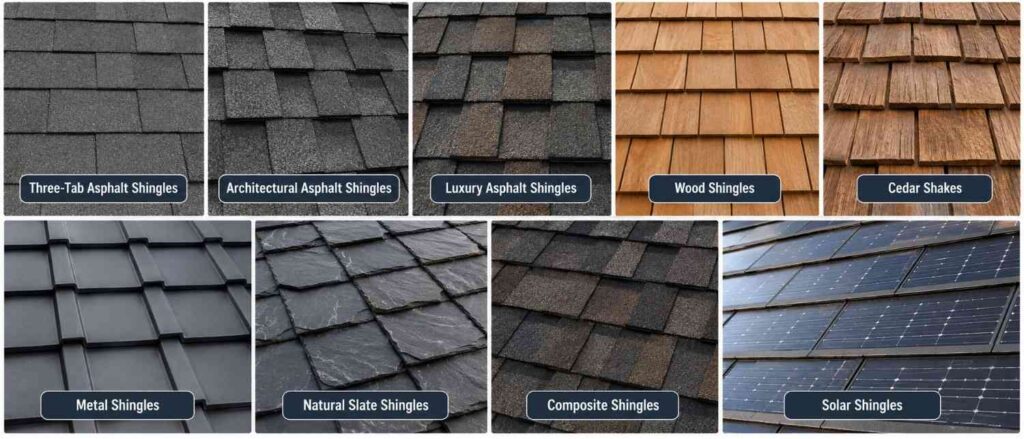
9 Types of Shingles for Residential Properties
1. Three-Tab Asphalt Shingles
Three-tab shingles are basic, single-layer asphalt products with cutouts that create three visible tabs. They form a flat pattern and are generally the least expensive asphalt option, but usually provide less visual depth and a shorter expected service range than heavier products.
2. Architectural Asphalt Shingles
Architectural shingles also called laminated or dimensional shingles, use layered construction to create varied shadow lines. Among the main types of asphalt shingles, architectural products often make sense for a primary residence.
Compare wind ratings, impact classifications, algae resistance, color availability, and installation requirements rather than assuming every architectural product performs the same.
3. Luxury Asphalt Shingles
Luxury or designer shingles are thicker asphalt products made to resemble slate, cedar, or tile. Their deeper profile suits detailed facades and larger roof planes where standard shingles may look too flat.
The trade-offs are higher cost and added weight. Confirm that the roof deck is sound and ask whether matching pieces should remain available for future repairs.
4. Wood Shingles
Wood shingles are sawn on both faces, producing a smoother finish than most shakes. They complement cottages, historic homes, and properties where natural materials are central to the design.
Leaves, moss, shade, and trapped moisture can accelerate wood deterioration. Local fire-rating requirements, treatment options, and insurance conditions should also be reviewed before installation.
5. Cedar Shakes
Cedar shakes create a thicker, rougher roof surface. The Cedar Shake & Shingle Bureau explains that shingles are generally sawn on both sides and thinner at the butt, while shakes are usually split on one or both sides, with some exceptions.
Shingles create a cleaner and more uniform pattern, while shakes provide deeper texture and a rustic appearance. Cedar performance depends heavily on product grade, spacing, ventilation, flashing, and maintenance.
6. Metal Shingles
Metal shingles are formed panels designed to resemble slate, tile, wood, or conventional shingles. Their performance depends on the base metal, protective coating, fastening system, and installation details.
Metal usually costs more upfront than asphalt, but it can provide decades of service with relatively low routine maintenance. The Metal Roofing Alliance gives a general service range of approximately 30–50 years or more.
Valleys, chimneys, skylights, and wall intersections require experienced installation. For a cost-focused comparison, read metal roof versus shingles cost.
7. Natural Slate Shingles
Natural slate is quarried stone cut into individual roofing units. It offers natural color variation and historic character that synthetic products cannot exactly reproduce.
High-quality slate may perform for 75 years or much longer, depending on its grade, fasteners, flashing, workmanship, and maintenance.
Slate is heavy, expensive, and brittle under careless foot traffic. A structural review may be needed before replacing a lighter roof, and repairs should be completed by contractors with slate experience.
8. Composite or Synthetic Shingles
Composite shingles are engineered to reproduce the appearance of slate or cedar with less weight. They may suit homeowners who want a premium appearance without the structural demands of natural slate.
Because quality varies considerably, compare third-party testing, wind and impact ratings, fire classification, warranty exclusions, approved accessories, and manufacturer history. Ask how replacement pieces could be sourced several years after installation.
9. Solar Shingles
Solar shingles are building-integrated photovoltaic products that form part of the weather-facing roof while generating electricity. Their lower profile appeals to some homeowners who prefer them to rack-mounted solar panels.
They are not suitable for every property. Solar potential depends on usable roof area, shade, direction, slope, location, and roof condition.
The agreement should clearly identify who is responsible for flashing, electrical work, monitoring, repair access, removal, and warranty coverage.
How to Choose the Right Roof Shingles
The most reliable way to compare types of shingles is to begin with the property, not a product brochure.
Inspect the Existing Roof
Check the deck, slope, ventilation, flashing, valleys, penetrations, and drainage. A roof that has leaked around a chimney, skylight, or sidewall may require carpentry and flashing work before new shingles are installed.
Future repair access also matters. A material may perform well but become inconvenient if replacement pieces are difficult to source or only a small number of local contractors can service it.
Match the Material to the Climate
Wind, rain, snow, ice, heat, humidity, tree cover, and freeze-thaw cycles affect roofing materials differently.
New York City projects may also involve attached buildings, narrow access, parapet walls, neighboring properties, and complex roof-to-wall transitions. These conditions can influence material delivery, flashing design, installation time, and total project cost.
Compare Total Installed Cost
The shingle price is only one part of the project. Tear-off, disposal, deck repair, underlayment, ventilation, flashing, permits, scaffolding, and limited access can change the total substantially.
Compare cost with the expected ownership period. A budget roof may suit a short-term plan, while a premium system may make more sense when longer service, distinctive appearance, and lower maintenance are priorities.
Check Weight, Slope, Warranties, and Approvals
Heavy luxury shingles and natural slate may require structural review. Low-slope roofs may need special underlayment or another roofing system entirely. Always follow the manufacturer’s minimum-slope, fastening, and ventilation requirements.
Material and workmanship warranties cover different risks. Review exclusions, transfer rules, prorated periods, required accessories, approved installers, and maintenance responsibilities.
Most construction in New York City requires Department of Buildings approval or permits, although some minor repairs may qualify for exceptions. Landmark properties can have additional review requirements.
For a wider comparison, see common roofing materials and their benefits.
Which Roof Shingle Is Best?
There is no universal winner.
Three-tab asphalt suits strict budgets. Architectural asphalt is a strong all-around option for many homes. Luxury asphalt adds visual depth. Metal favors long-term ownership. Slate fits selected historic or premium properties. Composite offers a high-end look at lower weight, while solar shingles combine reroofing with electricity generation.
The best option is the one that fits the building after its structure, slope, drainage, climate, repair access, maintenance needs, and total installed cost have been evaluated.
SK Group NYC Corp can inspect an existing roof and help New York City property owners compare practical repair or replacement options. Learn more about shingle roof installation and repair or its roofing services in NYC.
Frequently Asked Questions
What Are the Main Types of Roof Shingles?
The main types of shingles include asphalt, wood, cedar shake, metal, natural slate, composite, and solar products. Asphalt is divided into three-tab, architectural, and luxury categories. The right choice depends on roof slope, structure, weather exposure, budget, maintenance, and appearance.
What Are the Three Types of Asphalt Shingles?
The three categories are three-tab, architectural, and luxury shingles. Three-tab is the basic single-layer option. Architectural shingles use laminated construction for dimension, while luxury products are heavier designer shingles that may resemble slate, cedar, or tile.
Which Roof Shingles Last the Longest?
Natural slate generally has the greatest service potential, while quality metal systems can also last for decades. Product grade, flashing, fasteners, installation, climate, maintenance, and foot traffic all affect actual performance.
What Is the Most Affordable Roof Shingle?
Three-tab asphalt is generally the least expensive common option. Architectural asphalt costs more but often provides a stronger combination of appearance and service. Compare complete estimates that include removal, decking, flashing, ventilation, labor, access, permits, and disposal.
Are Architectural Shingles Better Than Three-Tab Shingles?
Architectural shingles are usually thicker and more dimensional, with broader design and performance choices. They are often a better fit for a primary residence, while three-tab shingles remain useful when upfront price and a simple appearance are the main priorities.
How Do I Choose Shingles for My House?
Begin with an inspection of the deck, slope, flashing, ventilation, drainage, structure, and access. Then compare product ratings, repairability, maintenance, appearance, warranty terms, and total installed cost. Eliminate unsuitable materials before comparing colors and styles.
Final Thoughts
Choosing among the types of shingles should begin with how the roof is built and exposed not with a sample board alone. Compare structural weight, slope limits, climate performance, repairability, maintenance, appearance, warranties, and total installed cost. Make sure the deck, underlayment, flashing, ventilation, and fastening plan support the selected material.
For New York City properties, SK Group NYC Corp can evaluate existing conditions and discuss appropriate shingle repair, installation, or replacement options. A site-specific inspection provides better guidance than choosing by price, appearance, or advertised lifespan alone.
Have Questions? Call Us Now!
+1 (718) 507-7000
We’re here to help quick answers, friendly service, anytime you need!
Contact SK Group NYC
🌐 Website: www.skgroupnyccorp.com
📍 Serving: Manhattan, Brooklyn, Queens, The Bronx, and Staten Island
📍 Address: 87-88 172nd St, Jamaica, New York, NY, United States, New York