Flat roofing is a low-slope roof system designed to protect a building while moving water toward drains, scuppers, or gutters. Despite the name, a properly built flat roof is not completely level. It needs enough pitch, often created by framing or tapered insulation to keep rain and melting snow from sitting on the membrane.
For property owners and managers, the right roof depends on climate, drainage, roof traffic, budget, existing conditions, and installation quality.
What Is Flat Roofing?
Flat roofing describes waterproof roof assemblies used on roofs with little visible pitch. These systems are common on commercial buildings, multifamily properties, garages, additions, and some modern homes.
A typical assembly includes a structural deck, insulation, waterproof membrane, flashing, edge details, and drainage. A premium membrane can still fail early if drains clog or seams are poorly installed.
NRCA guidance cites a common code minimum design slope of 1/4 inch per foot for many low-slope membrane systems, although the correct design depends on the roof assembly and applicable code.
Is a Flat Roof Actually Flat?
No. A flat roof should normally have enough slope to move water toward drainage points. The pitch may be almost invisible from the ground, but it is critical.
Poor drainage can lead to ponding water, wet insulation, membrane stress, and leaks. On reroofing projects, drainage should be evaluated before a new membrane is installed.
How Does a Flat Roof Work?
A low-slope roof works as a layered waterproofing system. The deck supports the assembly, insulation controls heat flow and may create slope, and the membrane provides the main water barrier. Flashing protects transitions around walls, drains, equipment, pipes, and roof edges.
Interior drains, scuppers, gutters, and overflow provisions move water away. That is why the roof should be viewed as a complete system rather than just a sheet of material. Drainage, substrate condition, flashing details, attachment method, and workmanship can matter as much as the membrane itself.
Main Types of Flat Roof Systems
TPO Roofing
TPO, or thermoplastic polyolefin, is a single-ply membrane widely used on commercial roofs. Its seams are typically heat-welded, and reflective colors are available.
Best suited for: many commercial and light-industrial roofs.
Key advantage: heat-welded seams and reflective options.
Main limitation: performance depends heavily on installation quality and system specification.
EPDM Roofing
EPDM is a flexible synthetic rubber membrane with a long history of use. It is commonly installed in large sheets, with seams joined using compatible tapes or adhesives.
Best suited for: residential additions, garages, and many commercial roofs.
Key advantage: flexible, established membrane technology.
Main limitation: seams and flashing need careful preparation and maintenance.
PVC Roofing
PVC is a single-ply thermoplastic membrane with heat-welded seams. Its resistance to many oils, fats, and chemicals makes it useful for restaurants and certain industrial facilities.
Best suited for: roofs exposed to grease or chemicals.
Key advantage: chemical resistance and welded seams.
Main limitation: higher initial cost than some alternatives.
Modified Bitumen Roofing
Modified bitumen combines asphalt with polymer modifiers for added flexibility and durability. Systems may be self-adhered, torch-applied, hot-applied, or cold-applied.
Best suited for: smaller commercial roofs, multifamily buildings, and roofs with regular service access.
Key advantage: durable, layered construction.
Main limitation: installation method and workmanship are critical.
Built-Up Roofing
Built-up roofing, or BUR, uses multiple layers of bitumen and reinforcing felts, usually protected by gravel, mineral surfacing, or a coating.
Best suited for: commercial buildings where a multi-ply system is preferred.
Key advantage: redundancy and durable surfacing.
Main limitation: weight, labor, and more complex installation.
Flat Roof Materials Comparison
| System | Typical Service-Life Range* | Strongest Use Case | Main Consideration |
|---|---|---|---|
| TPO | 20–30 years | Large commercial roofs | Seam and installation quality |
| EPDM | Often 20+ years | Flexible residential/commercial use | Dark surface and seam maintenance |
| PVC | 15–30 years | Restaurants, chemical exposure | Higher initial cost |
| Modified Bitumen | 10–30 years | Roofs with service traffic | Installation method |
| BUR | 15–20 years | Multi-ply commercial assemblies | Weight and labor |
*These are planning ranges, not guarantees. Material quality, climate, drainage, traffic, maintenance, and installation can shorten or extend service life. GAF likewise notes that commercial-roof longevity varies significantly by system and conditions.
How Much Does Flat Roofing Cost?
There is no reliable one-price answer because the membrane is only part of the project. Current U.S. consumer cost data places many installed flat-roof materials broadly around $4 to $14 per square foot, while complete replacement costs vary substantially by roof size and project conditions.
Major cost drivers include roof area, membrane type, tear-off, wet insulation, damaged decking, tapered insulation, flashing, drainage, access, permits, labor, and rooftop equipment.
Owners should compare scope, system specification, warranty terms, and substrate repairs—not just price per square foot.
How Long Does a Flat Roof Last?
A well-designed low-slope roof can provide decades of service, but lifespan is never determined by membrane type alone.
GAF’s 2026 guidance lists typical commercial-roof ranges of about 20–30 years for TPO, 15–30 years for PVC, 10–30 years for SBS modified bitumen, and 15–20 years for BUR.
Actual performance depends on UV exposure, climate, roof traffic, drainage, maintenance, and installation quality.
Pros and Cons of Flat Roofing
Advantages
Efficient roof space: Low-slope roofs can accommodate HVAC equipment, solar arrays, and service walkways without increasing the building footprint.
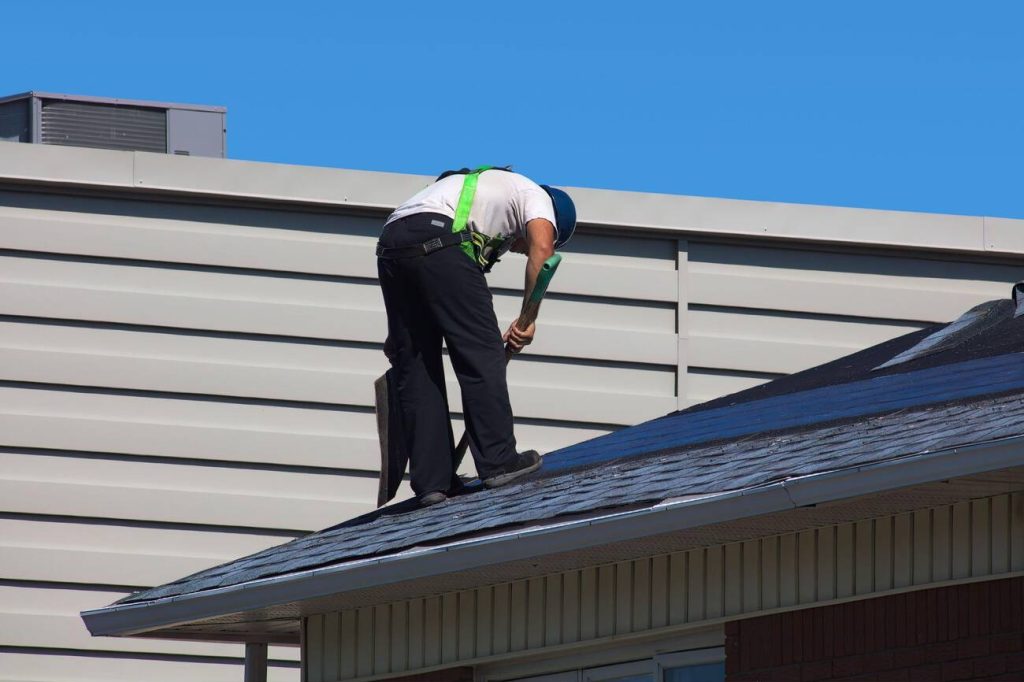
Easier service access: Technicians can generally reach rooftop equipment more easily than on steep roofs, although proper fall protection is still required.
Multiple material choices: TPO, EPDM, PVC, modified bitumen, and BUR give owners options based on climate, traffic, exposure, and budget.
Reflective options: Light-colored membranes can reduce solar heat gain and may lower cooling demand in suitable buildings.
Disadvantages
Drainage is less forgiving: Poor slope or blocked drains can create ponding water.
Puncture risk: Tools, debris, and repeated service traffic can damage some membranes.
More vulnerable details: Drains, pipes, HVAC curbs, wall transitions, and roof edges all require careful flashing.
Maintenance matters: Open seams, failed sealants, debris, and blocked drains can turn small defects into larger repairs.
What Is the Best Material for a Flat Roof?
There is no universal winner. The best material depends on how the building is used.
For large commercial roofs, TPO may suit projects prioritizing reflectivity and installation efficiency. EPDM offers flexibility, PVC suits grease or chemical exposure, and modified bitumen or BUR may fit roofs where layered durability and service traffic matter.
In New York, selection should also account for temperature swings, snow, freeze-thaw conditions, drainage, parapet walls, and rooftop equipment.
A contractor should inspect the deck, insulation, drains, penetrations, and existing roof layers before recommending a system.
Residential vs. Commercial Flat Roofs
Residential low-slope roofs often cover garages, porches, extensions, or modern home sections. Commercial roofs usually have more equipment, drains, penetrations, service traffic, and larger areas.
Those differences affect membrane choice, attachment, insulation, drainage, access, and maintenance planning.
Common Flat Roofing Problems
Common issues include ponding water, clogged drains, open seams, punctures, failed flashing, blisters, deteriorated sealants, wet insulation, and leaks around penetrations.
Ponding water is especially important because the visible water may be a symptom rather than the root cause. The underlying issue could be a blocked drain, inadequate slope, compressed insulation, structural deflection, or a poorly designed previous repair.
Early diagnosis can keep a localized defect from becoming a larger repair.
How to Maintain a Flat Roofing
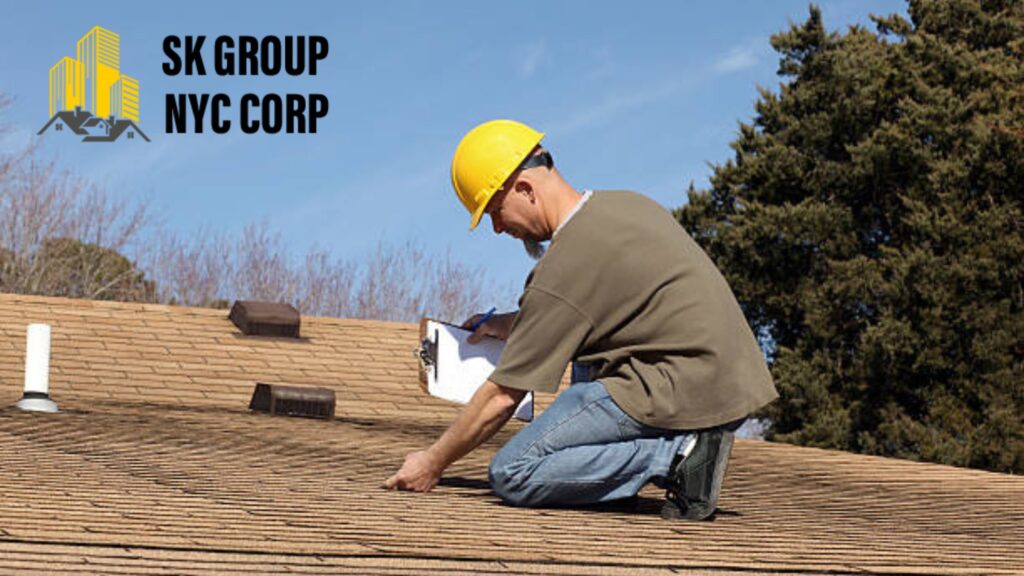
Inspect the roof at least annually and after major storms, while following manufacturer or warranty requirements. Keep drains, scuppers, and gutters clear, remove debris, and check seams, flashings, sealants, roof edges, and equipment areas.
For New York property owners, SK Group NYC Corp can evaluate membrane condition, drainage, flashing, penetrations, and visible signs of moisture before recommending repair or replacement. A useful inspection should identify the cause of a problem, not simply cover the symptom.
Frequently Asked Questions
Is a Flat Roof Completely Flat?
No. A properly designed low-slope roof has a slight pitch that moves rainwater and melting snow toward drains, scuppers, or gutters.
Which Flat Roof Material Lasts the Longest?
There is no single winner in every situation. TPO and PVC are commonly planned for multi-decade service, while EPDM can also provide long service life when properly specified, installed, and maintained.
How Often Should a Flat Roofing Be Inspected?
At least once a year is a practical baseline, with additional inspections after severe storms, construction activity, or rooftop equipment work. Warranty documents may require a different schedule.
Can Solar Panels Be Installed on a Flat Roof?
Yes. Low-slope roofs can be suitable for solar, but the structure, membrane protection, wind loads, drainage, mounting system, and future maintenance access should be reviewed first.
Is Flat Roofing Suitable for a House?
Yes. It can work well on modern homes, garages, additions, and urban properties when the roof is designed correctly for drainage, insulation, and waterproofing.
When Should a Flat Roof Be Replaced Instead of Repaired?
Replacement may make more sense when the membrane is widely deteriorated, leaks are recurring, insulation is wet across substantial areas, drainage requires major correction, or repeated repairs are no longer economical.
Choosing the Right Flat Roof System
The strongest flat roofing decision starts with the building, not the product brochure. TPO, EPDM, PVC, modified bitumen, and BUR all have legitimate strengths, but material alone does not determine success.
Compare drainage, climate, roof traffic, energy goals, existing conditions, maintenance expectations, service-life goals, warranty terms, and total project scope. Then evaluate whether the proposed assembly solves the building’s actual problems.
A well-selected membrane installed over a sound substrate with correct slope, flashing, drainage, and maintenance can provide reliable long-term protection. That system-level approach is more valuable than choosing a roof based only on the lowest initial price.