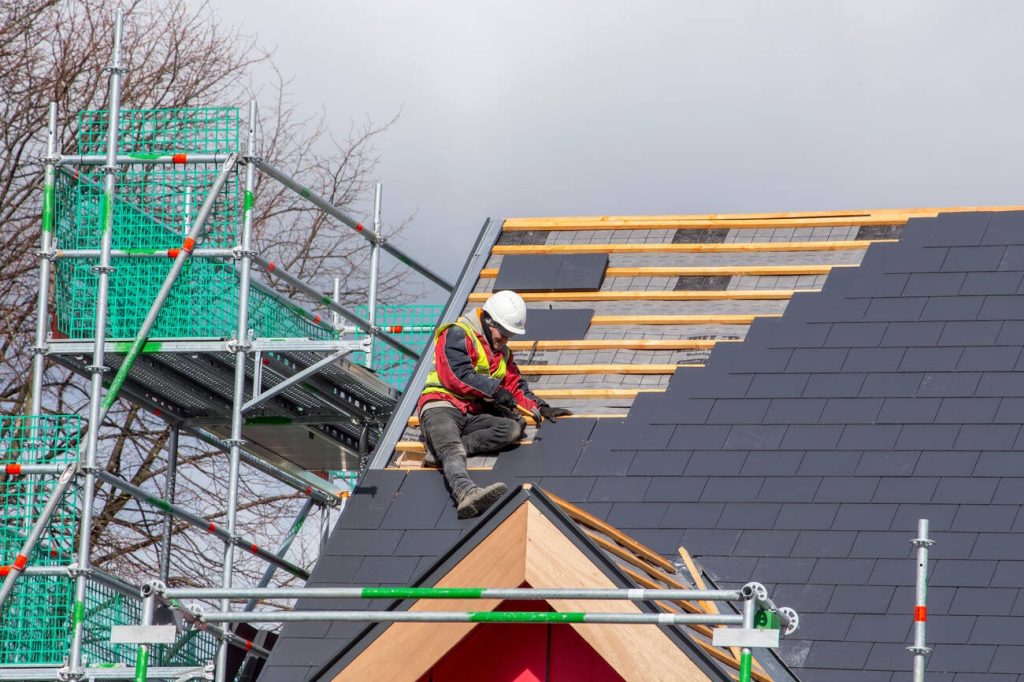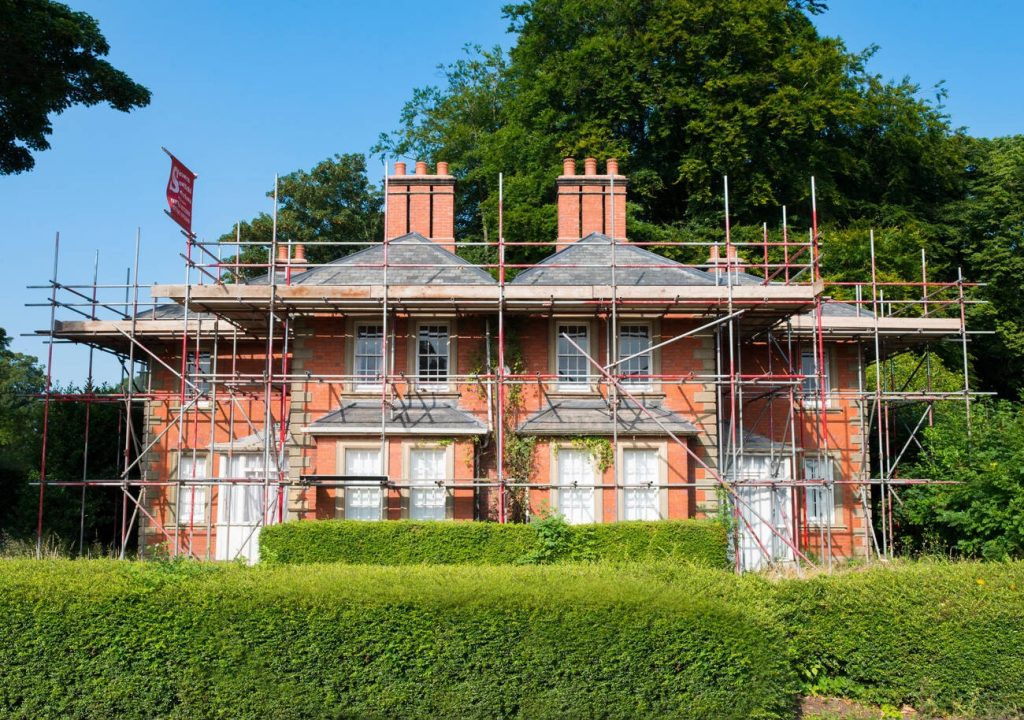
A successful commercial property requires more than just construction, it requires strategic planning, expert execution, and the right building approach. Commercial construction services help businesses create functional, durable, and efficient spaces, from modern offices and retail locations to industrial facilities and large-scale renovations.
The right construction partner manages every stage of a project, including planning, design coordination, budgeting, permits, construction management, and final delivery. With professional expertise, businesses can reduce risks, control costs, and develop spaces that support long-term growth.
This guide explores the key types of commercial construction projects, the construction process, industry trends, common mistakes to avoid, and how to choose the right construction company for your business.
What Are Commercial Construction Services?
Commercial construction services are professional solutions used to plan, design, build, renovate, and manage commercial properties such as offices, retail locations, industrial facilities, healthcare buildings, and hospitality spaces.
Unlike residential construction, commercial projects typically involve larger structures, complex engineering requirements, multiple stakeholders, strict building regulations, and detailed project management.
A professional commercial construction company works with architects, engineers, contractors, suppliers, and business owners to ensure every stage of development is completed efficiently and according to project goals.
Key Components of Commercial Construction Services
A complete commercial construction solution may include:
- Pre-construction consultation and planning
- Site evaluation and feasibility analysis
- Architectural and engineering coordination
- Construction cost estimation
- Commercial building construction
- Office and retail development
- Industrial facility construction
- Commercial renovation and expansion
- Construction project management
- Quality inspections and final handover
The goal is not only to complete a building but to create a space that improves business performance, functionality, and long-term value.
Why Businesses Need Professional Commercial Construction Services
Commercial construction projects involve significant investments of time, money, and resources. Without proper expertise, businesses may experience budget overruns, construction delays, compliance issues, or quality problems.
Working with experienced professionals helps businesses manage these challenges and achieve better project outcomes.
Better Planning and Project Strategy
Successful construction begins before the first phase of building starts. A detailed planning process helps identify project requirements, timeline expectations, budget considerations, and possible challenges.
Professional contractors evaluate:
- Site conditions
- Building requirements
- Material selection
- Construction timelines
- Regulatory requirements
- Future expansion opportunities
Strong planning creates a clear roadmap and reduces unexpected issues during construction.
Cost Control and Budget Management
Construction costs depend on many factors, including building size, materials, labor, location, and design complexity.
Experienced commercial contractors use detailed cost estimation and resource planning to help businesses make informed financial decisions.
A professional approach allows companies to:
- Understand realistic project costs
- Avoid unnecessary expenses
- Select suitable materials
- Manage resources effectively
Proper budgeting ensures that quality is maintained without unnecessary financial waste.
Quality, Safety, and Regulatory Compliance
Commercial buildings must meet strict safety standards, building codes, and industry regulations.
Professional construction teams focus on:
- Safe working environments
- Quality materials
- Proper installation methods
- Regulatory compliance
- Detailed inspections
Strong safety and quality practices protect workers, businesses, and future building occupants.
Types of Commercial Construction Projects
Commercial construction covers a wide variety of industries. Each project requires a customized approach based on business needs, building purpose, and operational requirements.
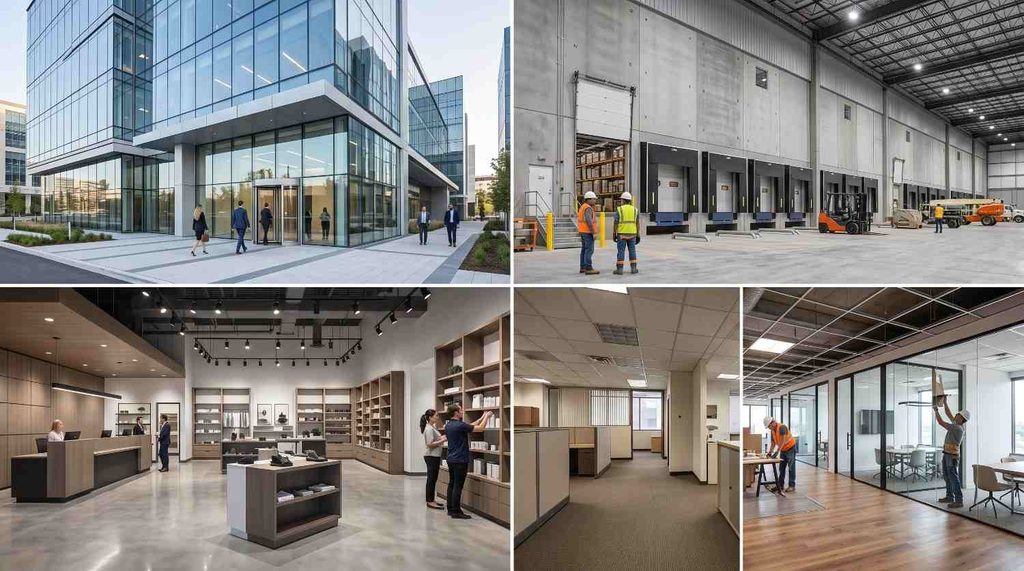
Office Buildings and Corporate Workspaces
Modern office construction focuses on creating productive environments that support employees, technology, and collaboration.
Professional office construction services often include:
- Flexible workspace planning
- Meeting and conference areas
- Technology integration
- Energy-efficient solutions
- Employee-focused designs
A well-designed office can improve productivity while creating a stronger professional image for the company.
Retail, Hospitality, and Customer-Focused Spaces
Retail stores, restaurants, hotels, and entertainment facilities require designs that balance appearance with functionality.
Retail construction services focus on:
- Customer movement patterns
- Brand-focused interiors
- Durable materials
- Attractive layouts
- Comfortable customer experiences
Hospitality projects require additional attention to guest satisfaction, accessibility, and unique design features.
Industrial and Manufacturing Facilities
Industrial construction projects require specialized planning because they often involve production areas, warehouses, heavy equipment, and advanced infrastructure.
Professional industrial construction services help businesses develop facilities that improve:
- Workflow efficiency
- Safety performance
- Storage capacity
- Operational productivity
Commercial Renovation and Expansion Projects
Many businesses choose to upgrade existing properties instead of constructing completely new buildings.
Commercial renovation services help companies:
- Modernize outdated spaces
- Increase usable areas
- Improve energy efficiency
- Adapt buildings for changing needs
Renovation projects can improve property value while extending the useful life of existing structures.
Commercial Construction Process: From Concept to Completion
A successful commercial project follows a structured process to ensure efficiency, quality, and accountability.
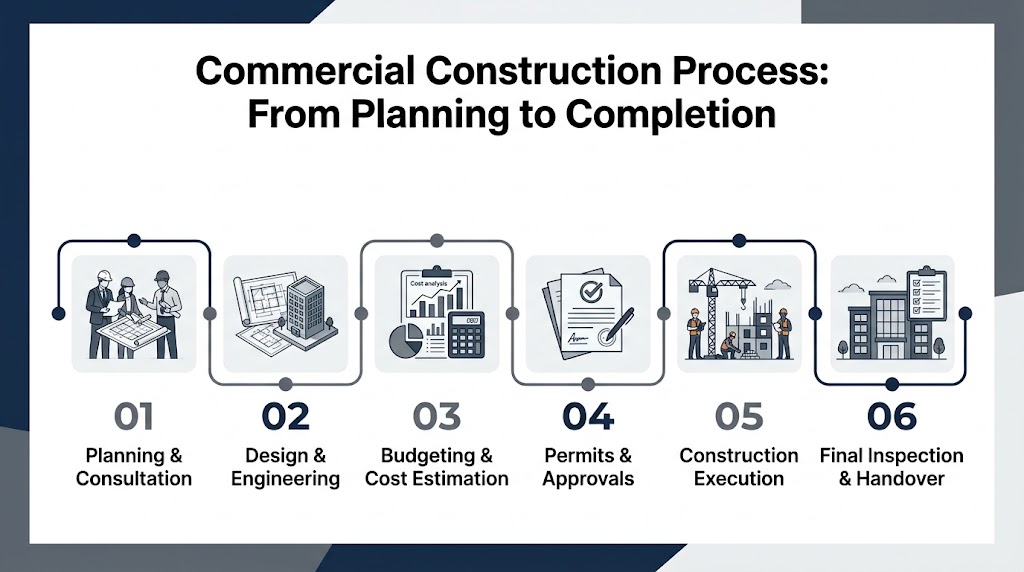
| Construction Stage | Main Purpose |
|---|---|
| Consultation & Planning | Understanding business goals, requirements, and budget |
| Design & Engineering | Creating technical plans and construction solutions |
| Cost Estimation | Developing realistic financial projections |
| Permits & Approvals | Meeting legal and regulatory requirements |
| Construction Execution | Managing materials, labor, safety, and timelines |
| Final Inspection | Ensuring quality before project delivery |
Pre-Construction Planning and Consultation
The pre-construction phase establishes the foundation of the project. Contractors evaluate the site, understand business objectives, and develop a realistic construction strategy.
This stage helps identify potential challenges before they become expensive problems.
Design, Engineering, and Approvals
Architects and engineers work together to create designs that balance aesthetics, functionality, safety, and compliance.
Proper coordination during this stage helps prevent costly changes during construction.
Construction Management and Execution
During construction, project managers coordinate workers, suppliers, schedules, inspections, and safety procedures.
Effective construction project management keeps the project organized and helps maintain deadlines.
Final Inspection and Project Handover
Before completion, the building undergoes final inspections to confirm that quality standards and requirements have been achieved.
Once approved, the completed space is ready for business operations.
How Design-Build Construction Improves Commercial Projects
The design-build approach combines design and construction responsibilities under one coordinated team.
Instead of managing separate contracts with architects and contractors, businesses can work with a unified construction partner.
Benefits of an Integrated Construction Approach
Design-build construction can provide:
- Better communication between teams
- Faster decision-making
- Reduced project conflicts
- Improved cost control
- More efficient project delivery
This approach is becoming increasingly popular because businesses want smoother construction experiences with fewer complications.
Commercial Construction Trends Businesses Should Know in 2026
The construction industry continues to evolve as businesses demand smarter, more efficient, and environmentally responsible buildings.
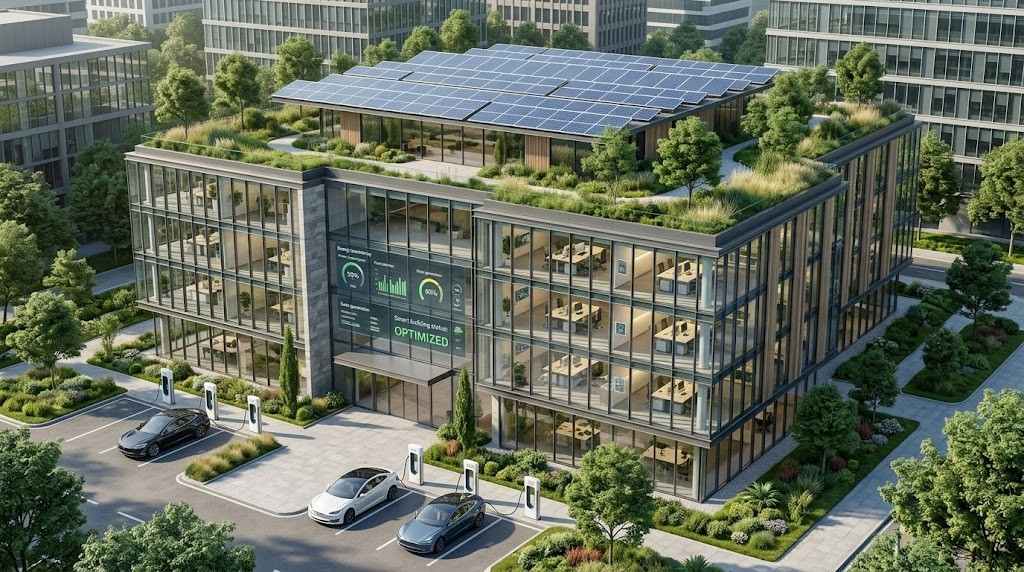
Sustainable and Energy-Efficient Buildings
Many companies are investing in sustainable construction solutions that reduce energy consumption and operating costs.
Popular approaches include:
- Energy-efficient lighting
- Sustainable materials
- Improved insulation
- Environmentally responsible building practices
Smart Building Technology
Modern commercial buildings increasingly use technology to improve efficiency and control.
Examples include:
- Automated lighting systems
- Smart security solutions
- Energy monitoring systems
- Connected building management platforms
Flexible and Future-Ready Commercial Spaces
Businesses need buildings that can adapt as their needs change.
Flexible designs allow companies to:
- Expand operations
- Reconfigure workspaces
- Support changing business models
Future-ready construction creates long-term value.
Common Mistakes Businesses Make During Commercial Construction
Avoiding common mistakes can save businesses significant time and money.
- Selecting Contractors Based Only on Price: The lowest bid may not always provide the best value. Businesses should evaluate experience, quality standards, communication, and previous projects.
- Ignoring Long-Term Building Requirements: A commercial property should support future growth, not only current needs. Proper planning should consider expansion and changing business requirements.
- Poor Communication and Project Planning: Clear communication between owners, contractors, architects, and engineers is essential for successful project delivery.
How to Choose the Right Commercial Construction Company
Selecting the right contractor directly affects project success.
Industry Experience and Portfolio
Review previous projects to understand the company’s expertise and ability to handle similar construction requirements.
Project Management Capabilities
A reliable construction company should have strong systems for managing schedules, budgets, materials, and teams.
Safety Standards and Transparency
Choose a contractor that prioritizes safety, provides clear communication, and maintains transparency throughout the project.
Why Businesses Choose SK Group NYC Corp for Commercial Construction Services
A successful commercial project requires a construction partner that understands quality, efficiency, and business objectives.
SK Group NYC Corp provides professional construction solutions focused on reliable project execution, quality workmanship, and client satisfaction.
The company understands that every commercial project has unique requirements, from early planning and design coordination to construction management and final completion.
By working with an experienced team, businesses can create functional, durable spaces designed to support long-term success.
Frequently Asked Questions
What are commercial construction services?
Commercial construction services include professional solutions for designing, building, renovating, and managing business properties. These services support offices, retail spaces, industrial facilities, and other commercial developments while maintaining quality and safety standards.
How long does a commercial construction project take?
The timeline depends on project size, location, design complexity, permits, and construction requirements. Smaller renovations may take weeks, while larger commercial developments can require several months or longer.
How much do commercial construction services cost?
Costs depend on factors such as project size, materials, labor, location, and design requirements. Businesses should request detailed estimates from professional contractors for accurate budgeting.
What makes a good commercial construction company?
A reliable commercial construction company should have industry experience, strong project management skills, quality standards, transparent communication, and a proven record of successful projects.
Why is construction project management important?
Construction project management keeps budgets, timelines, teams, and resources organized. Effective management reduces delays and helps ensure the project meets quality expectations.
Final Thoughts
A commercial building represents a major investment in the future of a business. Creating a successful space requires more than construction materials; it requires expertise, strategic planning, and professional execution.
Investing in quality commercial construction services helps businesses develop efficient, safe, and future-ready properties that support growth and success.
By partnering with an experienced company like SK Group NYC Corp, businesses can approach construction projects with confidence and create spaces built for long-term value.
Have Questions? Call Us Now!
+1 (718) 507-7000
We’re here to help quick answers, friendly service, anytime you need!
Contact SK Group NYC
🌐 Website: www.skgroupnyccorp.com
📍 Serving: Manhattan, Brooklyn, Queens, The Bronx, and Staten Island
📍 Address: 87-88 172nd St, Jamaica, New York, NY, United States, New York